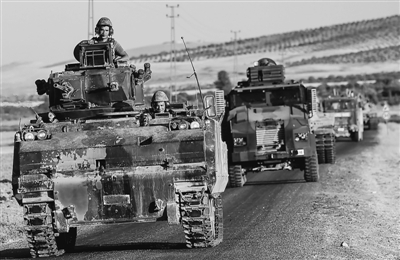
In late August, Turkey launched a military operation codenamed "Shield of the Euphrates River" against extremist organizations located in Syria. The picture shows that on September 2, Turkish soldiers returned to Turkey in armored vehicles after completing their military tasks.
People’s vision
On September 22, the Turkish military issued a statement saying that Turkey would continue the "Shield of the Euphrates River" military operation. Since the operation began on August 24, 927 terrorist military targets have been hit, with a total of 3,707 shells fired. The day before, the Turkish Defense Minister said that Turkey would provide support to Syrian opposition forces and reiterated its determination to continue military operations in Syria. Analysts believe that the Turkish military intervention in the Syrian conflict has added new variables to the wrestling of big countries and regions, and the future regional situation may be more complicated.
The crisis continues, and the spillover effect makes the soil uneasy.
As the Syrian issue enters the sixth year, the Syrian government, the extremist organization "Islamic State" and various anti-government armed forces including Kurdish armed groups are constantly fighting, and the regional security situation is deteriorating. Turkey, which borders Syria, is the first to be affected: the domestic security situation is deteriorating and it is frequently attacked by terrorists. For a long time, Turkey’s "regional dividend" accumulated by relying on economic development and social stability has been gradually lost, and "zero-problem diplomacy" has been dubbed "zero-friend diplomacy" by the Middle East media.
At the same time, Kurdish armed forces in Syria and northern Iraq have always been a big worry for Turkey. They are in contact with the PKK in Turkey and seek to establish a Kurdish state. In March 2016, the Syrian Kurdish Democratic Alliance Party led the establishment of "Rojiawa — Although the Democratic Federation of Northern Syria has not been recognized by the international community, the Kurdish forces have expanded significantly. In July, the Syrian Kurdish militia "People’s Defence Force" continued to advance to areas including the strategic town of Manbiji.
Professor Selcuk, vice-chairman of Turkey’s International Strategic Research Organization, said in an interview with this reporter that the Kurds’ quest for independence has always been regarded by Turkey as the most serious national security hidden danger. With the stalemate of all parties in Syria, Syrian Kurds have been expanding their sphere of influence and have constituted de facto autonomy in northern Syria, which has made the Turkish government feel a real threat. If they cooperate with Kurds in Turkey, it is likely to bring unacceptable consequences to Turkey.
Turkish Foreign Minister cavusoglu said in response to the media’s purpose of the "Shield of the Euphrates River" military operation, "Turkey’s goal is to put ‘ Islamic State ’ Drive out of the border areas, "he also bluntly said," (Syrian Kurdish militia) must be transferred to the east of the Euphrates River. If they don’t do this, we will take the necessary action. "
Kill two birds with one stone, the timing of military action is subtle.
The "Shield of the Euphrates River" operation included many Turkish arms and services, including air force, artillery, tanks and special forces, and directly crossed the Turkish-Syrian border to fight in Syria to support the pro-Turkish Syrian opposition forces. Agence France-Presse commented that this cross-border strike was Turkey’s "most ambitious" action in the Syrian conflict.
Analysts believe that Turkey chose to send troops to Syria at this time. In addition to cracking down on extremist organizations "Islamic State" and Kurdish armed forces, it is more far-reaching to consider or seek to establish a security zone to completely block the possibility of Kurdish forces converging in northern Syria in space, so as to further control Kurdish forces and intervene in Syrian affairs in the future and accumulate necessary political chips.
The Financial Times reported that the security zone will extend southward from the Turkish-Syrian border town of Jerabulus, covering the strategic location of Mambiji, and will continue to Babu, about 50 kilometers away from Aleppo, with an area of 4,000 square kilometers. The commentary said that the establishment of a security zone under the responsibility of Turkey with international support will make Turkey the dominant force in the Syrian conflict.
According to Turkey’s vision, this safe area will be used to resettle refugees who have fled to Turkey since the outbreak of the Syrian conflict and become a strategic buffer zone between Turkey and Syria. However, the United States has always had reservations about the establishment of a safe area. The United States is worried that the establishment of a safe area will make the American-led international alliance assume more military responsibilities than simply providing air cover.
Affect the overall situation, regional powers have different reactions.
Turkish military intervention in Syria has caused concern among countries.
Iranian Foreign Ministry spokesman bahram Ghasemi had previously criticized Turkey’s ground military operations in northern Syria and demanded that Turkish troops cease fire and withdraw from Syrian territory as soon as possible. He said that Turkey’s cross-border actions violated Syria’s sovereignty and were "totally unacceptable".
On the 7th, the Russian Foreign Ministry issued a statement saying that Russia was uneasy about the Turkish army and the Syrian opposition armed groups it supported entering Syrian territory to carry out military operations. These actions were not approved by the legitimate Syrian government and were not authorized by the UN Security Council, which damaged Syria’s sovereignty and territorial integrity and complicated the situation in Syria.
The United States is quite embarrassed in Turkey’s military intervention in Syria. On the one hand, Turkey launched the "Shield of the Euphrates River" on the day when Vice President Biden of the United States visited, and this military operation also received air support from the United States. On the other hand, the targets of Turkey’s military strikes also included the Kurdish armed People’s Defence Force, which was highly valued by the United States. Although the United States was unhappy and questioned about this, it made arrangements for the "People’s Defence Force" in order to ease relations with Turkey and coordinate its anti-terrorism stance. This also reflects the complicated situation of the current Syrian crisis.
Professor Selcuk believes that the Syrian issue affects the whole body. Outside Syria, forces from the United States, Russia, Iran and Europe are trying to push the situation to their own advantage. Inside Syria, the Bashar government, the extremist organization "Islamic State" and various opposition forces also have interest disputes, and it is difficult for the opposition to form a unified position. Turkey’s military intervention has added new variables to the development of the situation in Syria, making it more complicated. How to end the military conflict as soon as possible, truly return to the track of political negotiations, and test the wisdom of all parties.
(People’s Daily, Cairo, September 23rd, by reporter Yunsong Wang)