It is an oolong to stop the tide, but are UP owners more "lazy"?

"Big UP owners with millions of fans like me can’t make money or even lose money."

On March 31st, King Xu, one of the top 100 UP owners with 3.85 million fans, suddenly announced that he would stop working.

Prior to this, the news of "UP main stop" appeared on social media from time to time, but it was not paid attention to as a phenomenon. This time, the case of King Xu was merged with the sporadic news of stopping the watch before, and # bilibili UP launched the stop watch tide # and rushed to the top of the hot search.

The impact of short videos, the decline of long videos, the inability of UP owners to make money, and the decline of bilibili’s profitability … All kinds of discussions followed.

The discussion of "Stop More Tide" is like tearing a barb, which makes bilibili and the producers and loyal users of medium and long videos feel the pain of the skin.

picture

Gone with the wind Not really.

Soon, a number of media issued a document pointing out that the stoppage did not form a clear trend.
According to our statistics, the only ones mentioned in this "stop more tide" are currentlythree’s placeTop 100 UP owners.
In addition to the above-mentioned UP owner @ Wang Xu who eats by his face, he directly said that "making videos does not make money or even lose money". The other two UP owners, @-LKs-, @ I am Weird Jun, all responded to other personal reasons.
But the anxiety continues.
Between leaving and staying, there is still a gray area. Although not many people left,However, do those who stay behind tend to fade out of bilibili and neglect their business?
The top 100 UP owners selected by bilibili every year from the three dimensions of professionalism, influence and innovation can be said to be the head of this platform. Based on this,We selected the top 100 UP owners in the past three years from 2020 to 2022., trying to "lift the light to highlight the heavy": if the stickiness of the platform to these head UP owners is fading, let alone the waist, legs and soles of the feet, which have not received more platform dividends.
Excluding the UP owners who have been cancelled and officially cancelled by bilibili, there are 234 "Top 100".
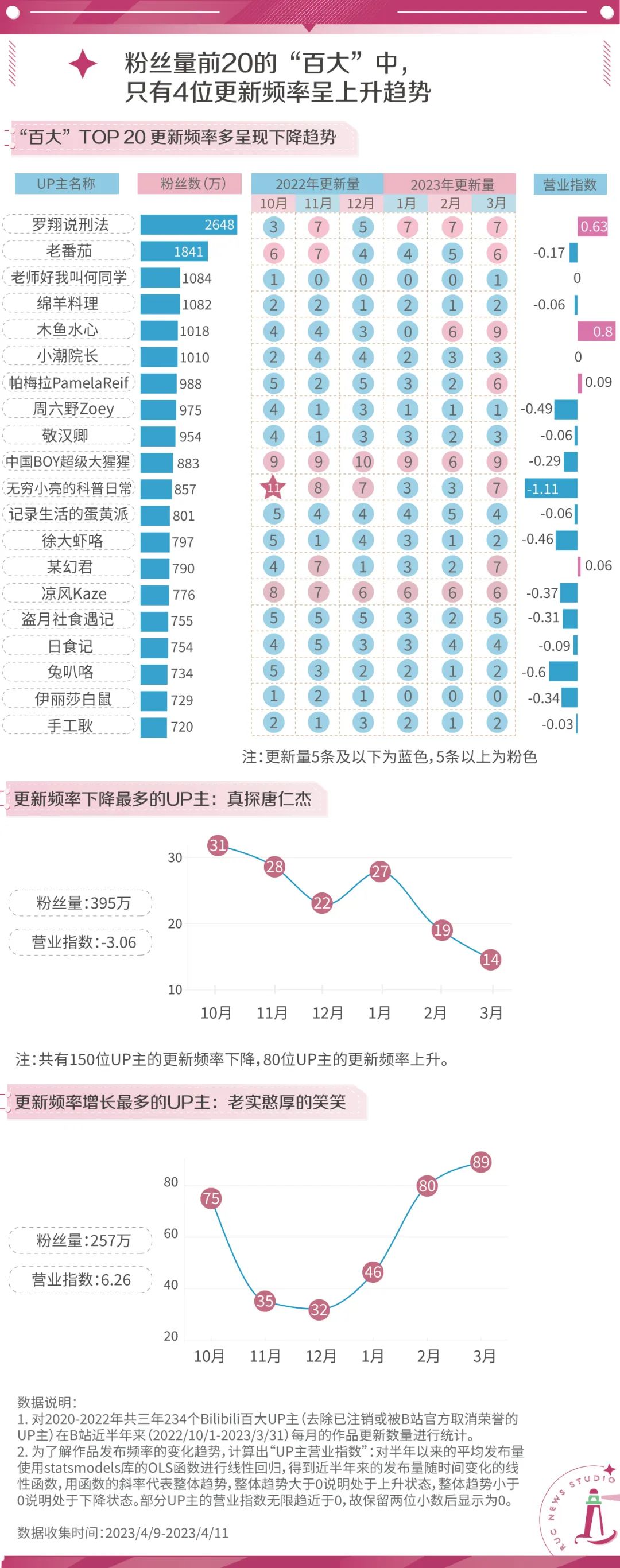
In order to understand the "business" frequency of UP owners, we calculated a"UP Main Business Index" (hereinafter referred to as "Business Index")In this paper, the number of videos published by UP owners in bilibili every month from October, 2022 to March, 2023 is linearly regressed by using OLS function of statsmodels library, and the linear function of publishing amount changing with time is obtained.The slope of the function represents the overall trend. If the overall trend is greater than 0, it means it is in an upward state, and if the overall trend is less than 0, it means it is in a downward state..

picture

According to the data, the frequency of 150 UP owners’ publishing content showed a downward trend within half a year, and the food blogger @ Zhentan Tangrenjie had the most declining update frequency, and the "business index" within half a year was -3.06.

There are 80 UP owners who are "redoubling their efforts". Game commentary blogger @ honest and honest smile can be described as a "model worker", and its "business index" is as high as 6.26, far exceeding the second-ranked film and television blogger "@ 中中中中中中中中" (business index 1.17).

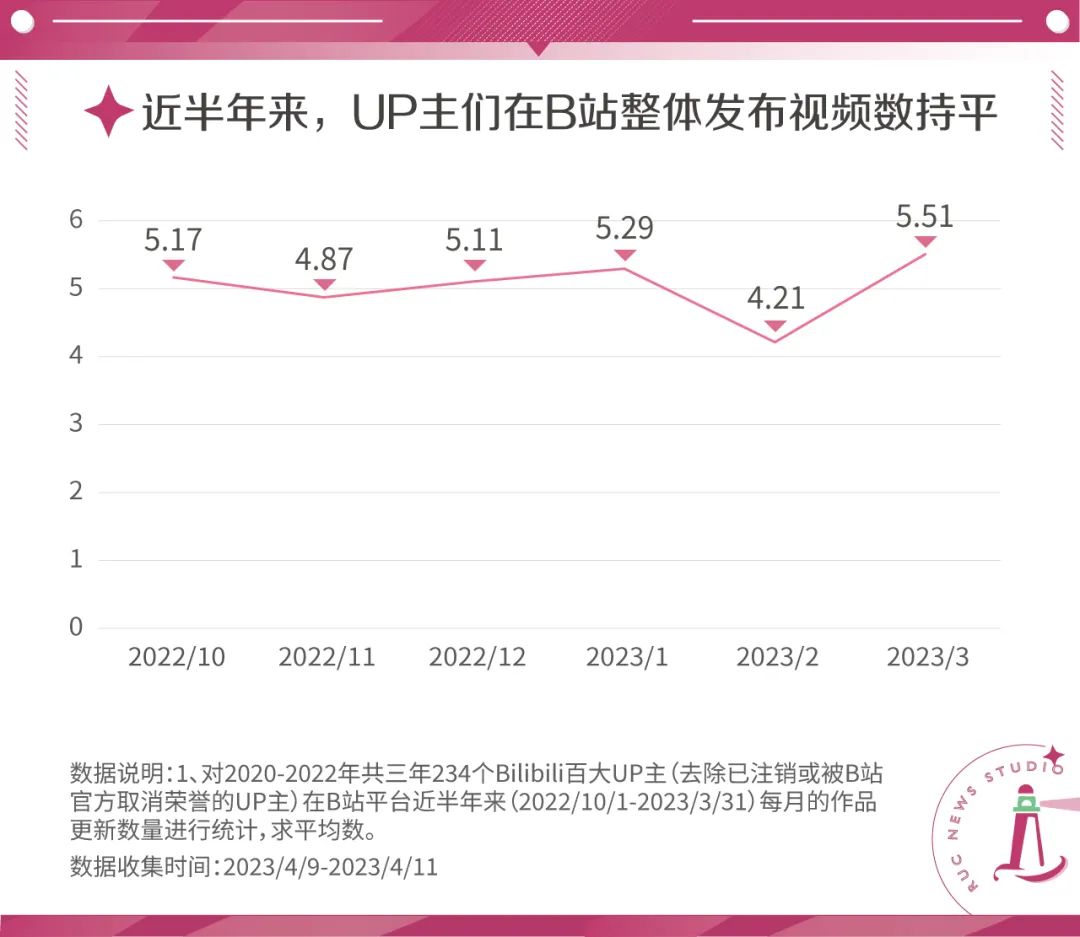
However,The business frequency of UP owners may be affected by specific time periods and personal circumstances.For example, in February 2023, affected by the Spring Festival, the average number of videos released by UP owners was only 4.21, which was much lower than other periods. In contrast, in the past six months, the average number of videos released by each UP owner is between 4 and 5, and there is no particularly big fluctuation.
picture
That is to say,There is no obvious "stopping the tide" among the head creators, but the overall update frequency shows a downward trend.
The other side of the story is that these people who stayed behind are not satisfied with the status quo and are actively exploring new creative soil.
picture

Which forest do the birds go to? Tik Tok or Little Red Book?

Where did the UP owners go when they were not in bilibili?

In this top 100 list,75% of UP owners have Tik Tok accounts with the same or similar ID as bilibili, and 49% have settled in Xiaohongshu.. Regardless of the length, video is still a track that UP owners are more familiar with.

The situation and development of the top 100 UP owners on other platforms are different.

In Tik Tok, nearly half of the top 100 UP owners have more than 1 million fans.Due to the high user activity of the Tik Tok platform itself, or because it is more suitable for the short-screen production environment, some UP owners are doing better in Tik Tok. For example, the fashion category UP owner @ Machamp Laochen, who has only 1.27 million fans in bilibili, has as many as 30 million fans in Tik Tok.

The platforms have their own tonality, and short videos and notes on planting grass are in vogue, but the ecology of the platform is not suitable for everyone. Sometimes, the new number is opened, but there is a "acclimatization".
"Hello teacher, my name is He", one of the top fans in bilibili with nearly 10.83 million fans. Although it was announced in high profile when I moved to Tik Tok, up to now, the number of fans in Tik Tok is 760,000, only 7% of that in bilibili. Xiaohongshu is even more "bleak", with only 110,000 fans. However, in bilibili, the most distinctive games, ghosts and animals, and animation content are naturally incompatible with Xiaohongshu, so such bloggers rarely settle in. In contrast, beauty, fitness and fashion bloggers are more likely to be like a duck to water.
On the one hand, the success of "landing in different places" tests the stickiness of fans-whether they like this person or people on a certain platform, and whether they are willing to follow the creators across platforms. On the other hand, it also tests the understanding and adaptability of UP owners to the platform.

Switching from medium-long video to short video platform is by no means a job of "uploading content twice"Horizontal screen needs to be replaced by vertical screen with high probability; Film and television bloggers spend half an hour explaining in bilibili. In Tik Tok and Xiaohongshu, they need to be cut short and cut into installments. Beauty bloggers need to re-adjust the definition and filters, adjust the speech, and judge the makeup trend of a specific platform … This is the change of the whole creative logic from form to content.

It is not difficult to explain why many head UP owners still choose to guard the comfort zone of "small broken station" Bi Dao, He, Ti mo Feng and other big UP owners have little red books, but they almost never operate them, as if they "forgot their account passwords".

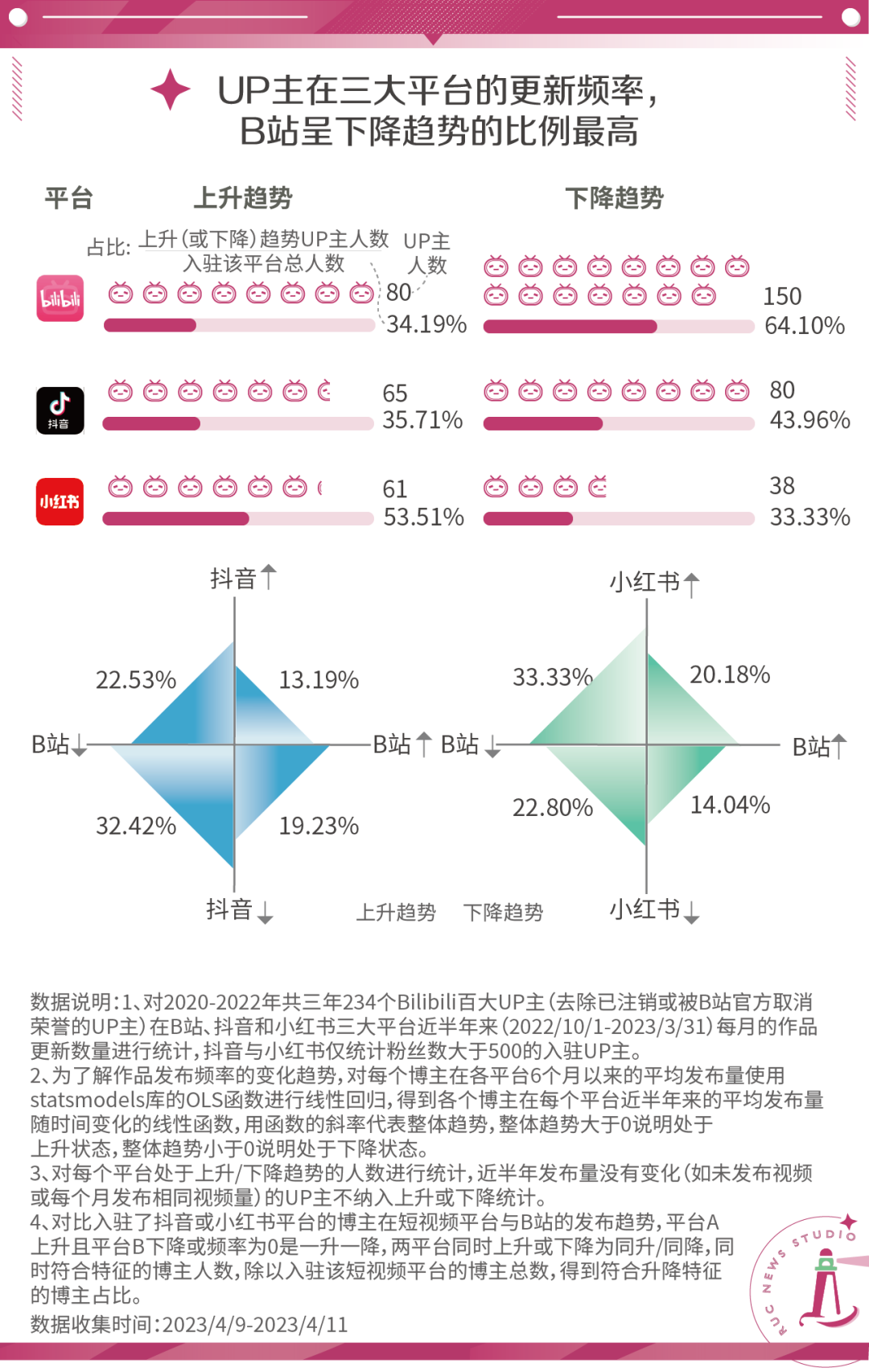
Judging from the overall trend in the past six months, the content publishing frequency of the three platforms has fluctuated, and bilibili’s "declining trend" is the most obvious. In Xiaohongshu and Tik Tok, the proportion of UP main update frequency is about 33% and 44%, while 64% of bilibili UP main business frequency has decreased.
picture
Among the UP owners who have settled in Tik Tok, 23% have increased their content in Tik Tok and decreased their content in bilibili. Among the UP owners who settled in Xiaohongshu, the content of Xiaohongshu increased, while the content of bilibili decreased, accounting for 33% of the total number. These UP owners are shifting their main energy from bilibili to other platforms.
picture

Creative odd jobs, what to live for?


Dreams are good, but money matters.

It may be an own goal to stop the tide, but the creators’ aspiration of "not making money" is true.

Creators can’t make money, which is inseparable from the commercial development of the platform. Even as the head UGC platform of domestic medium and long video, bilibili has been facing a profit dilemma. Until 2023, the goal put forward by Rui Chen, Chairman and CEO of bilibili, is still growth and breakeven; In the past year, bilibili’s total revenue increased by 13% year-on-year to 21.9 billion yuan, but the annual net loss was 7.5 billion yuan, up by 10% year-on-year.[1]. The market value has also suffered a decline for three consecutive years, silently expressing the market’s doubts about its commercial value.
Bilibili, which started from a sub-cultural community, stumbled for a long time on the road of commercialization.

In 2015, most of bilibili’s main income was concentrated in the mobile game sector (65.74%); By 2022, value-added services (39.80%) and advertising revenue (23.13%) represented by the payment of big members will become the main revenue. Better content and viewing experience need to be paid, and various forms of "just meals" by UP owners have gradually become the norm.

However, users seem to have a complicated attitude towards the commercialization tendency of platforms and creators.Although we can understand that "everyone needs a proper meal", we are always worried that when it becomes a "baton" for content creation, Utopia, once attached to interest, will also become a cold capital machine, and the creators will inevitably be alienated and become gears.
Sub-culture initially created identity for bilibili and attracted the same interests, but it also made these original users naturally reject the commercialization and large-scale development of the platform.If this tension can’t be solved, bilibili will "succeed and Xiao He will fail".

The bigger impact comes from short videos.
When the trend of short video surged, the "small broken station", which has always been proud of the long video in horizontal screen, also chose to "join if you can’t beat it". In 2021, it launched the Story-Mode of short video in vertical screen mode and began to try short video. By the end of March, 2021, the proportion of vertical video broadcast has exceeded 20% of the total broadcast, and it continues to rise.[2].

However, bilibili’s loss and positive convergence to short videos cannot be directly deduced to the overall decline of medium and long videos.Different medium and long video platforms have completely different profit models. For example, bilibili’s promise of no patch advertisement is an exception.
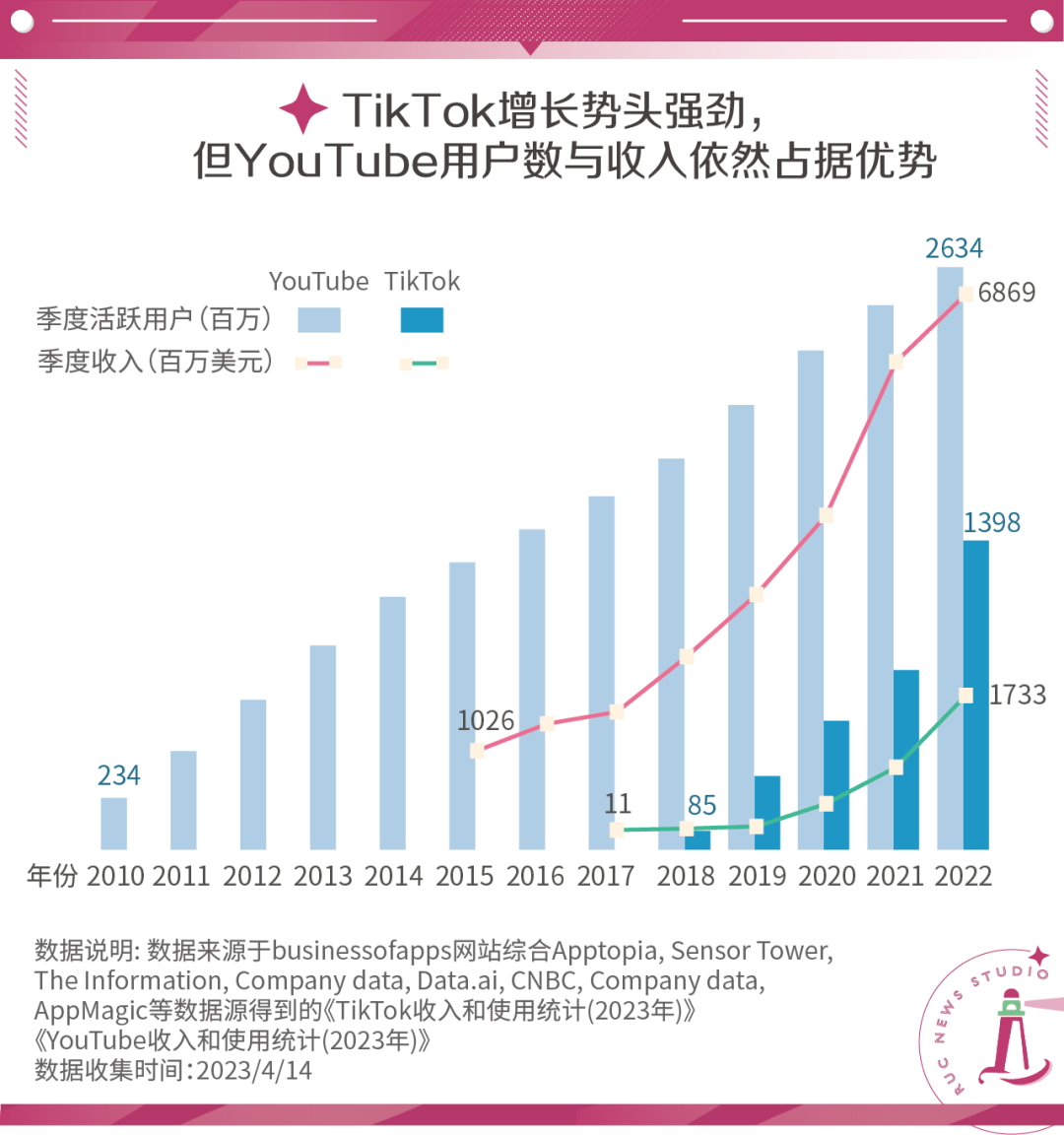
Looking far ahead, TikTok, a short video platform, has not yet shaken the long-standing "overlord" position of YouTube, a medium-long video platform. From the perspective of quarterly active users, the active users of YouTube are still twice as many as TikTok, and its market value is four times.
picture
Out of business logic, as a carrier, media is neither good nor bad, outdated or not, only appropriate.
But the reality is that creators need money to support their life and creation. When the UP owner becomes a job, his identity can no longer be a simple creator.Instead, you need to run your own business like a small company, self-marketing and self-promotion.[3].

The flow of attention determines the flow of capital, which also determines the flow of these "creative odd jobs" who make a living from it.So they lived by the grass and moved between different platforms. It is not only to find the soil for sowing ideas, but also to find channels with better remuneration and easier realization.
It seems too early to go from the rise of the popular Oolong in UP to the decline of bilibili, and then to sing an elegy for medium and long videos. We can even look forward to it optimistically.,In the confrontation and competition between old and new media, better expression and newer models will emerge.

After all, from papyrus to social networks, "new media" is always a relative concept.

References:

[1] Interface news: "Stop watch" reveals danger signal, bilibili can’t stay UP. "

https://mp.weixin.qq.com/s/871sGhfK2_5hyZZdoGD8JA

[2] "bilibili Releases Q1 Financial Report in 2021" https://b23.tv/oFplWJB

[3] Interface culture:The creation of odd jobs, widespread poverty:Talking from "bilibili stops the tide"

https://mp.weixin.qq.com/s/ELF_IOaD6RDmvMmG82Y9DQcv17024124? spm_id_from=333.999.0.0

Data: Cai Jingyuan, He Yuping and Ge Shurun Du Tianshu Lin Xin Yao Yu Wanyao Wu Jie Zhou Hongjie

Visualization:Zhou Hongjie Zhang Rui Wu Jie He Yuping Du Tianshu

Copywriting:Lin Xinyao and Yu Wanyao Ge Shurun

Editor: Cai Jingyuan

Reporting/feedback