(Article source: First Electric Network)
On April 28th, Tianjin Municipal Finance and Tianjin Municipal Commission of Industry and Information Technology jointly issued the Measures for the Administration of Local Subsidies for the Promotion and Application of New Energy Vehicles in Tianjin (2017) (hereinafter referred to as the Measures), and continued to implement the local financial subsidy policy for new energy vehicles promoted and applied in Tianjin in 2017.
The "Measures" stipulate that those sold in Tianjin from January 1, 2017 to December 31, 2017 and registered for the first time will be included in the Catalogue of Recommended Vehicles for the Promotion and Application of New Energy Vehicles issued and implemented by the state from 2017, which is in line with the Notice on Further Strengthening the Safety Service Guarantee for the Promotion and Application of New Energy Vehicles in Tianjin (Tianjin New Energy Promotion [2017] No.2). It is stipulated that pure electric and plug-in hybrid vehicles (including Among them, new energy passenger cars and special vehicles are given local financial subsidies in Tianjin according to 50% of the national financial subsidy standards, and new energy buses are given local financial subsidies in Tianjin according to 25% of the national financial subsidy standards. Manufacturers and distributors shall settle accounts with consumers at the price after deducting two levels of financial subsidies.
The "Measures" stipulate that new energy vehicles applying for local subsidies shall not be transferred across provinces (cities and autonomous regions) within three years from the date of initial registration in this Municipality. Individual users shall not transfer their cars to non-individual users within 2 years from the date of initial registration. During the existence of non-individual users, the purchased vehicles shall not be transferred within 2 years.
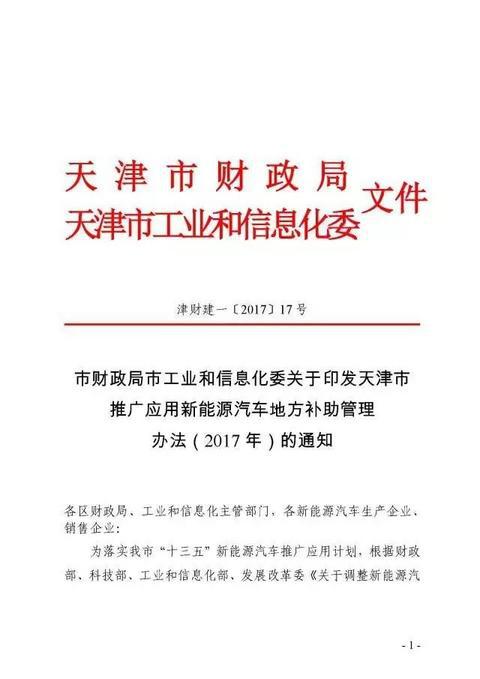
Measures of Tianjin Municipality on the Administration of Local Subsidies for the Promotion and Application of New Energy Vehicles (2017)
Chapter I General Provisions
Article 1 These Measures are formulated in order to implement the overall arrangement of the State on accelerating the development of new energy vehicles and further promote the popularization and application of new energy vehicles in our city.
Article 2 The term "new energy vehicles" as mentioned in these Measures refers to the pure electric and plug-in hybrid (including extended program) passenger cars, special vehicles and vehicles that have been sold and registered in this city for the first time, which are included in the Catalogue of Recommended Vehicles for the Promotion and Application of New Energy Vehicles issued and implemented by the State since 2017, and conform to the provisions of the Notice on Further Strengthening the Safety Service Guarantee for the Promotion and Application of New Energy Vehicles in Tianjin (Tianjin New Energy Promotion [2017] No.2) issued by the Municipal Commission of Industry and Information Technology and other six departments. New energy buses purchased with financial funds do not belong to the scope of these measures.
Article 3 The term "local subsidies for new energy vehicles" as mentioned in these Measures refers to the financial budget arrangement at two levels in urban areas, which is used to subsidize consumers in our city to buy new energy vehicles.
Article 4 The Municipal Finance Bureau, the Municipal Commission of Industry and Information Technology, the district finance bureaus and the competent departments of industry and information technology shall, in accordance with the relevant provisions of the state and our city, do a good job in the management of local subsidies for new energy vehicles.
The Municipal Finance Bureau and the District Finance Bureau are respectively responsible for the management and disbursement of subsidies for new energy vehicles in cities and districts.
The Municipal Commission of Industry and Information Technology is responsible for the promotion and application of new energy vehicle production enterprises and product management in Tianjin, accepting applications for local subsidies for new energy vehicles, and reviewing applications for local subsidies with the competent department of industry and information technology in the district. Among them, the Municipal Commission of Industry and Information Technology is responsible for the review of personal vehicles, the non-rental vehicles are reviewed by the competent department of industry and information technology in the district where the car purchase unit is registered, and the rental vehicles are jointly reviewed by the Municipal Commission of Industry and Information Technology and the competent department of industry and information technology in the district where the car purchase unit is registered.
Article 5 The management and disbursement of local subsidy funds for new energy vehicles shall follow the principle of "openness, justice and fairness" and accept supervision from all sectors of society.
Chapter II Subsidy Objects and Standards
Article 6 The target of local subsidies for new energy vehicles is consumers. New energy vehicles applying for subsidies should complete vehicle sales, invoicing, vehicle licensing and other matters from January 1, 2017 to December 31, 2017, and access the municipal monitoring platform and realize real-time exchange of vehicle monitoring data. Among them, the new energy vehicles purchased by non-individual users must apply for subsidies, and the cumulative mileage must reach 30,000 kilometers (except for special vehicles for work). For new energy vehicles whose mileage is not up to standard in that year, they should apply for subsidies after reaching the standard, and the subsidy standards and technical requirements shall be implemented in accordance with the annual driving license.
When selling new energy automobile products, new energy automobile production enterprises and sales enterprises shall settle accounts with consumers at the price after deducting state and local subsidies.
Article 7 The local subsidy standards for new energy passenger cars and special vehicles shall be implemented according to 50% of the national subsidy standards in the Notice of the Ministry of Finance, the Ministry of Science and Technology, the Ministry of Industry and Information Technology and the Development and Reform Commission on Adjusting the Financial Subsidy Policy for the Promotion and Application of New Energy Vehicles (Cai Jian [2016] No.958); The local subsidy standard for new energy buses shall be 25% of the above-mentioned national subsidy standard (Annex 1).
For each new energy vehicle, the total amount of state and local subsidies shall not be higher than 50% of the vehicle guidance price. For the excess part calculated according to the above subsidy standards, the local subsidy amount shall be reduced accordingly. The new energy vehicles promoted by vehicle manufacturing enterprises in other provinces and cities in Tianjin shall be deducted from the local financial subsidies at all levels stipulated in the current policy of the place where the enterprise is located when the amount of local subsidies in our city is approved.
Eighth individual users to buy new energy vehicles by the municipal finance subsidies, non rental units to buy new energy vehicles, by the district finance subsidies where the car purchase unit is registered. Rental units to buy new energy vehicles, by the city and the car unit where the district finance each according to the proportion of 50% subsidies.
Article 9 The annual subsidy for individual users to purchase cars shall not exceed 2 vehicles. In principle, the subsidy for non-individual users to buy a car is not more than 10 vehicles per year, and if they buy more than 10 vehicles per year, they should file a large-scale car purchase with the Municipal Commission of Industry and Information Technology before buying a car, explaining the purpose of the vehicle. Those who fail to fulfill the large-scale car purchase filing procedures as required shall not enjoy local subsidies.
Article 10 New energy vehicles applying for local subsidies shall not be transferred across provinces (cities and autonomous regions) within 3 years from the date of initial registration in this Municipality. Individual users shall not transfer their cars to non-individual users within 2 years from the date of initial registration. During the existence of non-individual users, the purchased vehicles shall not be transferred within 2 years.
Chapter III Declaration, Examination and Issuance of Subsidy Funds
Eleventh new energy automobile production enterprises are the main body responsible for the declaration of local financial subsidies. New energy vehicle manufacturers registered in this city can directly apply for local subsidies. New energy automobile production enterprises that are not registered in this Municipality shall, according to the types of vehicles such as passenger cars, special-purpose vehicles and buses, authorize the only automobile sales enterprise registered in this Municipality with independent legal personality to be responsible for applying for local subsidies, and assume relevant responsibilities and obligations as representatives of the production enterprises (Annex 2). During the authorization period, if the authorized sales enterprise changes, the production enterprise, the original authorized enterprise and the new authorized enterprise shall jointly apply for the change and submit written explanation materials (Annex 3).
Twelfth local subsidies for new energy vehicles are reported once every two months. The Municipal Commission of Industry and Information Technology shall, within 10 working days at the beginning of each month, accept the current local subsidy declaration of automobile production enterprises and sales enterprises (hereinafter referred to as the "applicant"). The applicant shall submit the following application materials:
(a) Tianjin new energy vehicle subsidy fund application (Annex 4);
(two) Tianjin new energy vehicle subsidy fund application information form (Annex 5);
(three) the vehicle sales invoice, motor vehicle registration certificate, a copy of the driving license, and the certificate of vehicle access to the municipal monitoring platform;
(four) a copy of the business license of the car purchase unit and the personal identity card of the car purchase;
(five) the application for local financial subsidy funds for non-individual users’ vehicles (except special vehicles for operation), the information summary table and the certification materials that the accumulated mileage has reached 30,000 kilometers (Annex 6);
(six) the stub form of the bank account of the reporting unit (Annex 7);
(seven) a letter of commitment to apply for the authenticity of local subsidy information (Annex 8).
The above materials shall be affixed with the official seal of the reporting unit in triplicate.
Article 13 After the materials submitted by the applicant have passed the examination, the Municipal Commission of Industry and Information Technology and the competent department of industry and information technology of the district shall, according to the division of responsibilities for examination, respectively publicize the examination results and the amount of subsidy to be granted on the portal website for five working days, and notify the municipal and district finance bureaus of the subsidy opinions without objection, respectively, and the municipal and district finance bureaus shall allocate local subsidy funds accordingly.
Chapter IV Supervision and Administration
Article 14 In accordance with the relevant provisions of the Notice of the Municipal Commission of Industry and Information Technology and other six departments on Further Strengthening the Safety Service Guarantee for Promoting the Application of New Energy Vehicles in Tianjin (Tianjin New Energy Promotion [2017] No.2), production enterprises and products that do not have the conditions to declare local financial subsidies will no longer enjoy local subsidies from the date of identification.
Fifteenth production enterprises in conjunction with the applicant to ensure that the application materials are accurate, complete and standardized. Vehicles whose application materials exceed the prescribed time limit will be delayed to cash the subsidy funds. For applicants whose application materials are inaccurate, incomplete and irregular for two consecutive times or three times in a year, their application acceptance for three cycles will be suspended.
Article 16 The Municipal Commission of Industry and Information Technology, together with the Municipal Finance Bureau, will entrust a third-party agency to regularly carry out follow-up inspection on the operation of new energy vehicles receiving local subsidies. If it is found that the vehicle information is inconsistent with the application materials, the vehicle products are inconsistent with the Announcement of Road Motor Vehicle Manufacturers and Products, providing false technical parameters and sales information, defrauding local subsidies and other illegal acts, causing major safety accidents such as explosion, fire and electricity leakage and failing to deal with them in time, and there are major safety hazards in product quality, and the vehicles have been idle for a long time after receiving local financial subsidies, once verified, the corresponding financial subsidies will be recovered or deducted, and local subsidies will be suspended and trademark models will be cancelled depending on the seriousness of the case.
Seventeenth new energy automobile production enterprises and their products have been found to be illegal by the relevant state departments, and make a decision on punishment, and their vehicles involved in Tianjin will be given synchronous punishment.
Chapter V Supplementary Provisions
Article 18 These Measures shall come into force as of January 1, 2017 and shall be valid until December 31, 2017. The Interim Measures for the Administration of Local Subsidies for the Promotion and Application of New Energy Vehicles in Tianjin (Jin Cai Jian Yi [2016] No.117) shall be abolished at the same time.
New Energy Vehicles in Tianjin in 2017Local subsidy standards and technical requirements
I subsidy standards and technical requirements for new energy buses
(1) Subsidy standards for new energy buses.
Subsidy amount = vehicle power × subsidy standard for unit power × adjustment coefficient (adjustment coefficient: system energy density/charging rate/fuel saving level), as follows:
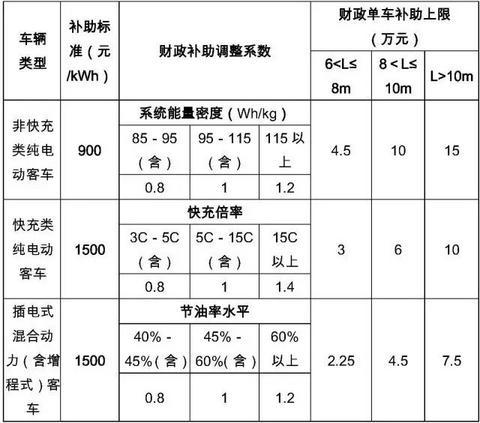
1。 Energy consumption per unit load (Ekg) is not higher than 0.24 Wh/km kg.
2。 The continuous driving mileage of pure electric buses (excluding fast-charging and plug-in hybrid buses) is not less than 200 kilometers (constant speed method).
3。 The ratio (m/m) of the total mass of the battery system to the whole vehicle kerb mass is not higher than 20%.
4。 The energy density of battery system of non-fast charging pure electric bus is higher than 85Wh/kg, the fast charging rate of fast charging pure electric bus is higher than 3C, and the fuel saving rate of plug-in hybrid bus (including extended range) is higher than 40%.
Two, new energy passenger car subsidy standards and technical requirements
(1) The subsidy standards for the promotion and application of new energy passenger cars and plug-in hybrid (including extended range) passenger cars are as follows:
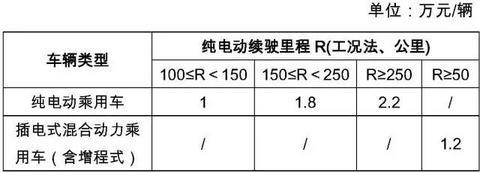
1。 The maximum speed of a pure electric passenger car for 30 minutes is not less than 100 km/h.
2。 The mass energy density of the power battery system of the pure electric passenger car is not less than 90Wh/kg, and the subsidy is 1.1 times higher than 120Wh/kg.
3。 For pure electric passenger car products, according to the different kerb mass (m) of the whole vehicle, the power consumption (y) per 100 kilometers under working conditions should meet the following requirements: when m≤1000kg, y ≤ 0.014× m+0.5; When 1000<m≤1600kg, y ≤ 0.012× m+2.5; When m = > 1600 kg, Y≤0.005×m+13.7.
4。 The fuel consumption of plug-in hybrid passenger car in state B (fuel consumption excluding electric energy conversion) with pure electric driving range less than 80km is less than 70% compared with the corresponding limit in the current national standard for conventional fuel consumption. The plug-in hybrid passenger car with pure electric driving range greater than or equal to 80km, its A-state 100 km power consumption meets the same requirements as pure electric passenger cars.
Three, new energy trucks and special vehicles subsidy standards and technical requirements
(a) new energy trucks and special vehicles to provide driving power for the total storage capacity of the power battery as the basis, to take the way to give subsidies in excess of the section, as follows:
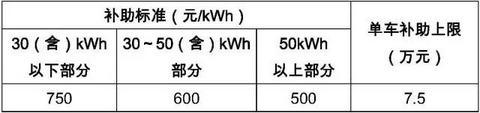
1。 The mass energy density of the power battery system is not less than 90Wh/kg.
2。 The energy consumption per unit load (Ekg) of pure electric trucks and transport special vehicles is not higher than 0.5 Wh/km kg, and the power consumption per ton of other pure electric special vehicles (according to the test quality) is not more than 13kWh.
Four, fuel cell vehicle subsidy standards and technical requirements
(1) The subsidy standards for the promotion and application of fuel cell vehicles are as follows:
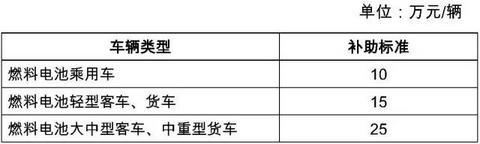
1。 The rated power of the fuel cell system is not less than 30% of the rated power of the driving motor and not less than 30kW. Fuel cell passenger cars with rated power of fuel cell system greater than 10kW but less than 30kW will be subsidized according to the rated power of fuel cell system of 6000 yuan /kW.
2。 The continuous driving range of fuel cell vehicles is not less than 300 kilometers.
V. Technical Requirements for Power Battery
The power battery used in new energy vehicles shall meet the following standards:
1。 Energy storage devices (monomer, module): zinc-air battery for electric road vehicles (standard number GB/T 18333.2-2015, article 6.2.4/article 6.3.4 will not be implemented for the time being), vehicle supercapacitor (standard number QC/T 741-2014), cycle life requirements and test methods of power battery for electric vehicles (standard number QC/T 741-2014) 6.5 Cycle life under working conditions will not be implemented for the time being), safety requirements and test methods of power storage batteries for electric vehicles (standard numbers GB/T 31485-2015, 6.2.8 and 6.3.8 are not implemented for the time being).
2。 Energy storage devices (battery packs): lithium-ion power battery packs and systems for electric vehicles Part 3: Safety requirements and test methods (standard number GB/T 31467.3-2015).