September is approaching, and the new soybean harvest is just around the corner. Since the Ministry of Agriculture and Rural Affairs implemented the soybean revitalization plan this year, the area of soybean sowing in spring and summer has increased this year. According to the Ministry of Agriculture and Rural Affairs, the national soybean planting area will exceed 130 million mu this year, an increase of more than 10 million mu over the previous year. On the other hand, due to the fact that the actual arrival of soybeans in Hong Kong in July was lower than expected, the Expert Committee on Market Early Warning of the Ministry of Agriculture and Rural Affairs recently released an analysis of the supply and demand situation of agricultural products in China in August 2019, and reduced the estimated soybean import in China in 2018/19 by 1.5 million tons. One increase and one decrease reflect the new situation facing China’s soybean industry.
In recent years, China’s soybean industry has achieved vigorous development, but it is also facing more uncertainties at all times. With the change of domestic and international environment, the supply and demand pattern of international soybean market has increased, and the domestic soybean market has also experienced some fluctuations. Facing the current opportunities and challenges, how can China’s soybean industry break through? Recently, at the 4th China Soybean Industry International Forum held in Harbin, Heilongjiang Province and the Discussion Forum on Innovation and Development of Industry-Finance Integration in the New Period, people from relevant government departments and authoritative industry experts at home and abroad interpreted relevant policies from all angles, analyzed market trends, and jointly discussed the innovative way of combining soybean and corn industries with finance and the road of industry transformation and development in China in the new period.
The planting area has increased, the import channels have been broadened, and the soybean supply has confidence in the second half of the year.
With the sporadic listing of early beans in Hubei, domestic soybean buyers and sellers gradually turned their attention to new-season soybeans.
Heilongjiang is a traditional high-quality soybean producing area, with soybean planting area and output accounting for more than 40% of the country. Affected by the adjustment of national soybean and corn planting subsidy policies and other factors, this year, large grain growers and cooperatives in Heilongjiang reduced the corn planting area, and their enthusiasm for planting soybeans increased significantly. The relevant person in charge of the Agriculture and Rural Affairs Department of Heilongjiang Province said that in 2018, the total soybean planting area in Heilongjiang was 53.51 million mu, and the total output exceeded 6.5 million tons; This year, the soybean planting area has exceeded 64 million mu, and the total output is expected to exceed 9 million tons.
Facing the recovery increase of soybean planting area for the fourth consecutive year, the industry generally believes that this has released a positive signal for the improvement of domestic soybean supply level.
"In the fourth quarter of last year and the first quarter of this year, there was no shortage of supply in the market, and the market supply was very stable. Even due to the decrease in sales of soybean meal feed, the supply of soybean meal in the market was relatively surplus." Regarding the supply and demand situation and price trend of soybeans this year, Wang Xiaohui, deputy director of the National Grain and Oil Information Center, believes that from a global perspective, the grain output is still in a stable trend of increasing production this year, and the pressure of increasing soybean production still exists. In the past period of time, the prices of corn, soybeans and wheat on the Chicago Mercantile Exchange in the United States have maintained a downward trend, which is a reflection of the relationship between supply and demand in price. On the other hand, the situation of domestic food supply exceeding demand has not changed, but with the continuous expansion of soybean import sources, the domestic market is abundant.
"The Russian Far East exports 600,000-800,000 tons of soybeans to China every year." Dmitry Rylko, a Russian agricultural expert and general manager of the Agricultural Market Research Institute, said that the freight for transporting soybeans from the Far East to central Russia, Novosibirsk and Altai is 55-60 US dollars per ton, and it is about 75-80 US dollars per ton if it is transported to the western central region of Russia, but it will be much cheaper if it is exported to China. "So the best market for the Russian Far East is the China market."
"From January to July this year, the soybean crushing volume decreased by 2.4 million tons year-on-year, and the decline rate was not too great. In April and May this year, the domestic soybean meal price once dropped to 2,400 yuan/ton. In the first quarter of this year, the proportion of soybean meal added in pig feed and other feeds increased compared with last year. " According to Zhang Liwei, director of the Market Information Division of the National Grain and Oil Information Center, the domestic demand for soybean meal has dropped significantly since July, and from January to July, the soybean crush was only reduced by 2.4 million tons compared with the previous year, so the supply is relatively abundant.
"In August and September, the number of live pigs will remain at a relatively low level, and the consumption of soybean meal will be relatively low." Zhang Liwei believes that in the third and fourth quarters, relying on domestic soybeans and soybeans imported from South America will not cause much problem in domestic supply.
"It is worth noting that in the context of tight supply of live pigs, a new round of pig cycle has arrived ahead of schedule. At present, the price of live pigs has shown a strong trend of shock. The market generally believes that the price of live pigs is expected to approach the previous high point in the second half of the year, so the expectation of a strong rise in pig prices will stimulate farmers to actively replenish their stocks, or it will have a marginal profit for the actual demand of soybean meal, which will also boost the price of soybean meal." He Lin, director of nanhua futures Agricultural Products Research Center, said.
Rely on technology to tap the potential, strengthen brand marketing ability, plant well and sell well
China is a major consumer of soybeans in the world, and at the same time, China’s dependence on soybean imports has been high. Yang Baolong, president of China Soybean Industry Association, said frankly that under the current international trade background, China’s soybean imports exceeded 80 million tons in 2018. The world soybean trade volume is 130-140 million tons, and China’s imports account for 2/3.
Faced with such a supply pattern, where should the development of soybean industry start? Gai Junyi, an academician of China Academy of Engineering and a professor of crop genetics and breeding at Nanjing Agricultural University, believes that facing the current gap between domestic soybean production and demand, the potential can be further tapped from the technical aspect. "The improvement of output is the key. Of course, it must be improved by varieties, and there must be breakthroughs in varieties on limited cultivated land." Gai Junyi said that in terms of varieties, it is necessary to strengthen the research on excellent genes of world seed resources for our use; It is also necessary to improve the level of science and technology in the process of production technology management; In addition, the use of modern information technologies such as remote sensing to promote the balance between production and demand and make a breakthrough in processing industry will play a positive role in improving the efficiency and efficiency of soybean industry and promoting its development.
"American soybean production is about 350-370 kg per mu, and the better one is 400 kg." Yang Baolong said that for some large farms in Northeast China, this output is very common, but the yield level of small retail investors is still around 220-250 kg per mu. In this regard, Yang Baolong suggested that on the one hand, we should make good use of the relevant support policies of the soybean industry to improve the level of agricultural modernization; On the other hand, it is necessary to plan the land scientifically.
Plant well and sell well. Yang Baolong believes that it is necessary to cultivate a number of leading domestic soybean processing enterprises and rely on the market to promote industrial development. At the same time, we should strengthen brand building, enhance brand marketing ability and solve problems with market thinking.
"In the past, no matter what kind of beans were planted, people bought them. Now it is different." Yang Guangjun, director of the domestic soybean sales center of China Grain Storage Company, said that this year, China Grain Storage will adopt the strategy of high quality and good price in the acquisition process, and separate protein beans from ordinary beans.
Make good use of futures tools, solve the problem of farmers’ income with the hand of the market, and improve the risk prevention and control ability of the industrial chain.
The demand of consumers is becoming the basis for some soybean growers to produce. In order to solve the problem of soybean sales and income, some cooperatives and farmers will adopt the order form and plant according to the requirements of end customers. "But there will be certain risks in this respect. What if the price is not as high as before?" Yang Guangjun believes that farmers’ interests can be effectively safeguarded through "insurance+futures".
"Farmers don’t have the ability to protect themselves. They can buy insurance first, and then reinsurance by insurance companies to futures companies, and hedge the price risk through the futures market to form a guarantee mechanism for farmers’ income." He Lin said.
In 2018, Liaoning Dalian Commodity Exchange launched a farmers’ income security plan to help farmers avoid risks through futures tools. In 2019, Dashang Institute launched the "Farmers’ Income Protection Plan" in combination with various innovative models such as "insurance+futures", OTC options and basis trade. The plan proposed the goal of county coverage, and the 13 pilot projects for county coverage included 5 soybean projects, involving a spot volume of 338,100 tons.
According to Liu Zhiqiang, assistant general manager of Dalian Commodity Exchange, in order to solve the problems of farmers’ grain storage, selling and financing, and further ensure farmers’ income from growing grain, Dashang actively explores and tries to launch a new grain bank model that combines the risk management function of futures market with traditional grain banks.
"After the harvest season every year, farmers are prone to mildew and deterioration when they leave their grain at home. Now we bring in futures companies, insurance companies, banks and leading enterprises to serve farmers and new agricultural operators." According to the person in charge of Dalian Commodity Exchange, through the grain bank, leading enterprises can first dry and preserve the grain in the hands of farmers. In the following period, farmers can sell it at the best market price according to the market trend, and leading enterprises can also pay some funds to farmers in advance. Insurance companies provide insurance services for producers. Futures companies hedge through the futures market to help enterprises lock in prices. On the one hand, banks get reasonable profits through poor income, and at the same time, they improve the security of payment and promote agricultural credit services. Banks can provide some funds to farmers in advance, and they can also provide loans to enterprises in advance. In this way, multi-party cooperation can solve the risks that falling prices may bring to farmers’ income through market-oriented means.
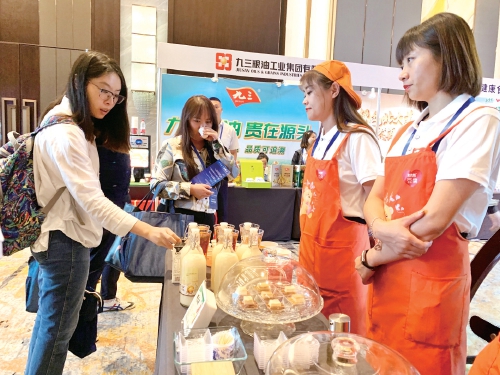
The downstream industry also needs a reasonable risk transmission mechanism. In 2017, nanhua futures and Jiusan Cereals and Oils Industry Group jointly launched the basic procurement. "That is to say, based on the price of futures, plus a premium, farmers will sell grain after pricing according to the price of futures, and enterprises can finally settle the grain payments according to the farmers’ ideas." He Lin introduced that this model of "insurance+futures+order agriculture" integrated enterprises into the whole industrial chain, which not only guaranteed farmers’ income, solved the problem of selling grain, but also solved the procurement problem of enterprises. In addition, under the current international trade background, it is a good strategy for enterprises to actively seek risk hedging tools and comprehensively use financial tools to avoid risks. (Reporter Zhao Yuheng)